





Open to visitors
Monday - Saturday
1 April to 31 October 9.30 am to 4.30 pm
1 November to 31 March 10 am to 4 pm
Sunday 2.00pm to 5.00pm
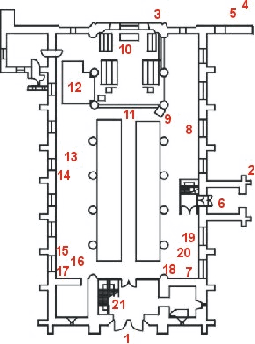
- The Cathedral is a fine example of a fortified kirk and the best view is obtained from inside the West gate. Instead of one large window, the mason has filled the space between the towers with seven "lights" or narrow windows. The twin towers are built in the fashion of 14th century tower houses with walls thick enough to contain spiral staircases to the upper floors and with battlements at the towerheads. When built the towers were completed by small cape houses (shown on the bishops window in the Cathedral) and these were replaced by spires in the time of Bishop Gavin Dunbar. This bishop was particularly interested in heraldry (compare the Bridge of Dee, Chaplain’s Court, Greyfriars Church and the ceiling here). At the corners of the spires are the shields bearing the arms of King James V and the bishop.
- Moving now to the south side, we see the porch surmounted by a crow-stepped gable - instead of sloping sides there are stone steps. Above the aisle wall and the nave wall can be seen stopped-up doors. From these walk-ways lead to the room above the south porch and the central tower (now gone).
- In the ruined transepts at the east end of the Cathedral, on the sandstone columns, there are carved features, a merman, mermaid and leaves. Craftsmen drew on fantasy as well as on nature to the glory of God.
- In the south transept is the tomb of Bishop Gavin Dunbar (Roman Catholic) died 1532, and immediately in front of this
- The tomb of Bishop Patrick Forbes (Scottish Episcopalian) died 1635.
- In the middle ages, each mason had his own personal mark to indicate the work he had completed. There are many such marks in St Machars and these can be seen most readily on the inside walls of the south porch above the wall seats.
- The "St Machar" window by Douglas Strachan, an Aberdeen artist, tells the traditional story of the founding of the first church in the 6th century.
- By the same artist, the Bishops window commemorates three "building bishops", Alexander Kinnimond II, Henry Lichton and William Elphinstone. It shows features of the Cathedral in the 14th, 15th and 16th centuries, including a cape house in the right hand light.
- The pulpit is 20th century and was recently enhanced by the 'Friends of The Cathedral'. An earlier Cathedral pulpit belonging to Bishop Stewart (1545) is now in King’s College Chapel.
- The east window (1953) is by William Wilson and shows the Nativity, the Last Supper, the Crucifixion and Christ in glory surrounded by the Scottish saints. In front of the window is the Communion Table with candelabra on either side.
- The choir occupy the stalls as they did in the middle ages.
- The organ was built by Willis in 1891.
- The font, designed by Hew Lorimer (1954), shows St Machar baptising converts, and also depicts the fish, which was an early Christian symbol or secret sign at a time of persecution. The Greek word for fish (ICHTHUS) forms an acrostic - Jesus, Christ, God’s Son, Saviour.
- Close by the north wall are examples of an aumbry (the old church name for a cupboard), and a piscina (a perforated stone basin for carrying away water after rinsing vessels used in Communion).
- Effigy of Canon Walter Idyll.
- Effigy of Bishop Henry Lichtoun, formerly in the north transept. In his time, 1424-1440, most of the nave was built.
- Various families have had long associations with the Cathedral, eg. the Paton family of Grandhome for more than 300 years.
- Memorial to Bishop Patrick Scougal. He lived in one of the tower rooms and died there in 1682.
- War memorials and tablets are often found in churches and cathedrals. This stone bears the names of members of the congregation of St Machar’s and St. Mary’s (formerly in the High Street) who died in two world wars. The stained glass window above (also part of the memorial) depicts the triumph of good over evil.
- It is the custom to lay up Regimental and King’s colours. Here in St Machar’s, these relate to the Scots Guards and the Gordon Highlanders.
- At the Bookstall, postcards, slides and Occasional Papers are on sale.
By prior arrangement, a visit to the bell tower can be made